In June 2025, the Ministry of Industry and Information Technology (MIIT) clearly proposed to implement the action of "artificial intelligence + manufacturing," accelerate the intelligent upgrading of key industries and create an "upgraded version" of intelligent manufacturing when reviewing the Key Points for Informatization and Industrialization Integration of the Ministry of Industry and Information Technology in 2025.
This statement not only releases the high attention paid by the state to the deep integration of "artificial intelligence + manufacturing," but also points out the direction for the manufacturing industry in the new round of technological revolution.
It means that under the AI tide, the manufacturing industry is facing deep-seated structural challenges and transformation pressure, standing on the threshold of "redefinition."
On the one hand, the accelerated restructuring of global industrial chain, the structural shortage of labor force, and the double pressure of quality and efficiency appear day by day; on the other hand, artificial intelligence is penetrating into every link from R & D, production to supply chain at an unprecedented speed, becoming a new variable driving the high-quality development of manufacturing industry.
In this context, manufacturing is no longer the follower of AI applications, but the main battlefield and main engine for its landing.
However, artificial intelligence enabled manufacturing is not only to improve efficiency and reduce cost, but also to deeply affect the logical structure, organization mode and governance ability of manufacturing system, and promote the evolution of manufacturing industry from process-driven to data-driven, from automation to intelligence, and from human control system to human-machine cooperation.
Therefore, the embedding of AI technology is starting a "redefinition" of manufacturing.
This article will focus on the integration trend of "artificial intelligence + manufacturing," disassemble from multiple dimensions such as landing path, typical application, key challenge and organizational capability, and explore how AI is embedded into manufacturing system from perception, control, execution, operation and decision-making, so as to promote manufacturing enterprises to move towards a more flexible, higher-quality and stronger future.
The landing path of "artificial intelligence + manufacturing": five iterations from perception to decision-making With the promotion of the deep integration of "artificial intelligence + manufacturing," the underlying architecture of the manufacturing system is undergoing a quiet but profound reconstruction.
Traditional manufacturing systems have long followed a clear hierarchical architecture of "perception-control-execution-operation-decision": sensors collect data and upload it to the control system, instruction-driven execution units, automated systems manage the process, and decision-makers plan and adjust based on periodic data analysis.
This top-down, centrally controlled, linear architecture once supported large-scale, standardized industrial production, but its limitations are becoming increasingly apparent in today's increasingly complex, dynamic, and changing manufacturing environment.
Today, the manufacturing industry is moving from hierarchical architecture to platform-based, integrated and decentralized system reconstruction. Perception, control, execution, operation and decision-making are no longer separated systems, but coordinated operation, real-time interaction and intelligent closed-loop on a unified technology platform.
In this architecture, the ability of artificial intelligence is no longer simply inserted into a certain link, but deeply embedded in the nerve center of the whole manufacturing network, becoming the support of system intelligence.
This paradigm shift also outlines the five iterative paths of AI landing in manufacturing:
1. Perceptual iteration: from "seeing" to "understanding"
The first step in manufacturing began with perception. With the development of AI video analytics, smart sensors, and the Industrial Internet of Things, the "eyes" of the manufacturing scene have become sharper and more insightful.
The AI-enabled video analysis system can automatically identify production abnormalities, fault warning and article status changes, which complements the limitations of traditional rule algorithms. At the data acquisition end, the sensor not only collects data, but also realizes preliminary analysis and event triggering through edge AI, providing real-time basis for subsequent control and execution. The strengthening of perception layer is the starting point for AI to fully intervene in manufacturing system.
2. Control Iteration: From "Rule Control" to "Intelligent Generation"
Intelligent control systems are rewriting the logic of industrial control. The new generation of industrial control system, represented by software defined automation (SDA), breaks the closed structure of binding hardware and programming in traditional control system, and constructs an open, modular and reconfigurable control platform.
On this basis, with the introduction of AI assistant tool, PLC programming is no longer a task completed by engineers alone. By describing the control target in natural language, AI can automatically generate control logic, flow chart, semantic annotation, even debug and verify, realize the transition from human-written code to human-computer co-writing, and improve the development efficiency and iteration ability of control system.
3. Execute Iterations: From Automation to Smart Synergies
Manufacturing execution layers are also changing. The deep integration of AI and industrial robots promotes the formation of "industrial agents" with the ability to perceive, judge and execute.
The robot driven by AI can not only complete repetitive operation, but also realize adaptive path planning, real-time visual recognition and multi-machine cooperative scheduling. Through digital twinning and simulation platforms, robots can be trained and verified in a virtual environment before deployment, greatly reducing the launch cycle. From then on, the "hands and feet" made are no longer just executing instructions, but intelligent executors with judgment.
4. Operational Iteration: From Records Management to Predictive Optimization
Manufacturing process management system is also fully reconfigured due to the introduction of AI. Artificial intelligence is accelerating to integrate into MES, equipment management system and other core platforms of production process, becoming the intelligent engine of manufacturing optimization.
AI can model equipment operation data, identify potential failures in advance, and realize predictive maintenance; optimize OEE performance through real-time data flow analysis; and in quality management, identify defect patterns and root causes with AI to improve product consistency and compliance. Manufacturing process management is moving from reactive control to predictive operation, enabling process-level, data-driven intelligent optimization.
5. Decision iteration: from "cycle lag analysis" to "real-time intelligent decision"
The decision-making of manufacturing enterprises is also ushered in intelligent transformation. AI will gradually have the ability to assist in high complexity decision-making tasks such as production scheduling, inventory simulation and quality prediction.
With the help of AI model, enterprises can carry out scenario simulation to quickly evaluate the resource occupation and delivery possibility of different scheduling strategies; combined with historical and real-time data, AI can predict the trend of quality fluctuation and adjust process parameters in advance; in inventory management, AI can dynamically recommend replenishment strategies to improve inventory turnover efficiency. Manufacturing decision-making changes from lagging response to forward-looking insight, which becomes the key support for enterprise agility and resilience.
In these five transitions, we see that artificial intelligence is no longer an external tool, but an intelligent factor within the manufacturing system. It crosses the traditional boundary, integrates into every level and every node, and promotes the manufacturing system from hierarchical control to intelligent collaboration, from local optimization to system intelligence.
This systematic restructuring is precisely the connotation of "artificial intelligence + manufacturing."
Manufacturing Organizations in the "AI +" Era: What System Capabilities Are Needed?
At a time of rapid development of artificial intelligence, one question that has been repeatedly discussed is: Will AI replace people? In manufacturing, this issue is particularly sensitive.
In the past, every leap forward in automation seemed to be accompanied by a trend toward "machines replacing people." However, today's artificial intelligence, especially the landing path in manufacturing scenarios, is telling us a definite answer: AI is not about reducing people, but about enhancing them.
According to the global survey data of "2025 Intelligent Manufacturing Status Report" released by Rockwell Automation Co., Ltd.,48% of manufacturing enterprises plan to transfer jobs or add new employees through intelligent manufacturing technology.
The report makes it clear that smart manufacturing needs more people, not fewer.
This means that the wide application of AI has not brought about a wave of layoffs, but has given rise to a strong demand for new skills and compound talents.
In the past, AI was seen more as a tool: to aid in detection, analysis of data, and reporting. Now, with the penetration of AI model in predictive maintenance, quality control, production scheduling and other links, it is gradually evolving from an auxiliary judge to a decision maker.
This evolution has not only changed the role of technology, but has also reshaped organizational structures. Manufacturing enterprises are shifting from the one-way relationship of "human decision-making and AI assistance" to the two-way collaborative mode of "man-machine co-decision." AI is no longer a background tool, but an intelligent element embedded in business process, participating in process evolution and triggering process reengineering.
This also means that the requirements of enterprises for talents are undergoing qualitative change: not only engineers who understand AI, but also AI talents who understand manufacturing are needed. AI generalist talents with cross-border ability, systematic thinking and business understanding will become the key support for the intelligent transformation of organizations.
If AI is the "brain" of intelligent manufacturing, then the ability to organize is the decisive factor in whether this "body" is flexible, strong and sustainable. Entering the AI era, manufacturing enterprises should not only introduce algorithms and tools, but also build a system capability system to support the landing, growth and expansion of AI. The key dimensions include:
1. Strategic capability: AI is not just an "IT project," but "business normality"
When many enterprises promote "artificial intelligence + manufacturing," they regard it as a one-off information upgrade, which is led by the IT department. This practice often leads to AI projects going high and low, pilot success, and replication failure.
The real transformation of intelligent manufacturing needs to regard AI as the core strategic resource driving the transformation of enterprise business model. AI should not exist independently of the business, but should be deeply embedded in core processes such as production, quality, supply chain, energy management, etc. AI strategy should be deeply bound with business strategy to form a two-wheel mode of "business traction + technology drive."
2. Talent ability: Building a compound echelon of "AI engineers + business experts" The optimization of talent structure is the premise of AI landing. On the one hand, enterprises need engineers with AI algorithm ability and data modeling ability to understand the structure, characteristics and noise of manufacturing data; on the other hand, manufacturing experts who understand business, process and operation need to participate in AI projects to make experience explicit and knowledge structured, so as to make AI model closer to realistic problems.
Bilingual talents of "engineering language + business language" will be the indispensable backbone of future manufacturing enterprises.
3. Organizational structure: AI projects promoting the co-construction of AI middle-level stations and businesses are often fragmented and difficult to replicate on a large scale. The fundamental reason lies in the lack of unified data and model bases. To this end, enterprises need to build AI and data middle-level platform with reuse capability, connect the underlying algorithm capability, data governance capability and business process, and form a two-layer architecture of "platform + scenario."
Organizationally, it is also necessary to set up an inter-departmental AI application committee or digital operation team to break down the barriers between IT and OT, R & D and manufacturing, and headquarters and the field, so as to realize the co-creation mode of asking questions from the front line and providing solutions from the platform.
4. Implementation path: from pilot to full-link deployment
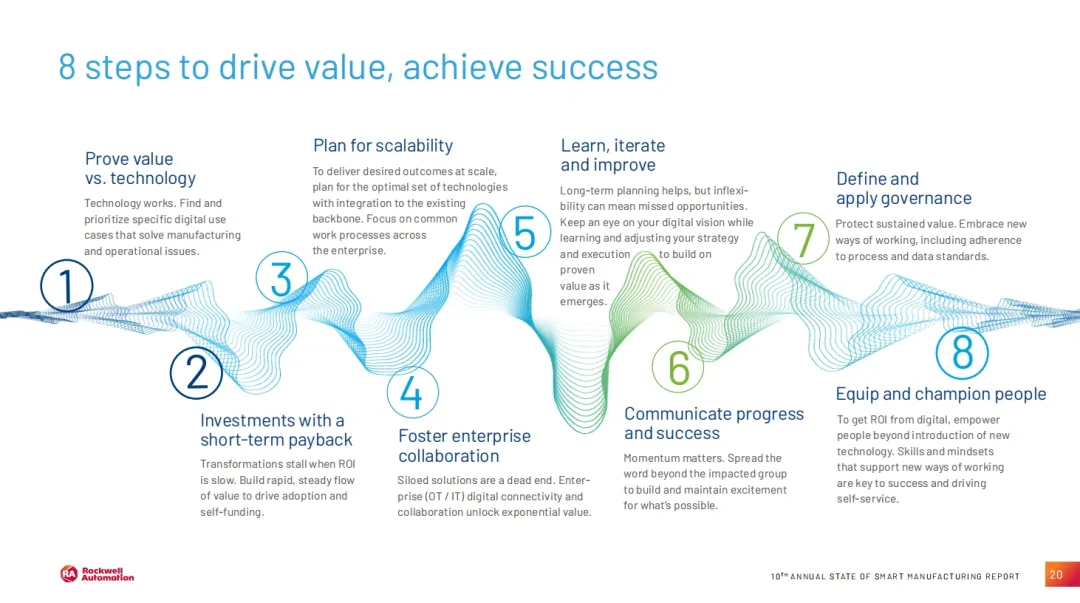
According to the intelligent manufacturing transformation path proposed in the research report, enterprises should follow the eight-step process of agile start, rapid iteration and continuous expansion when deploying AI projects, as shown in the figure above.
This path emphasizes that AI landing cannot be greedy for perfection, but should run in small steps, learn while doing, and gradually evolve to achieve a spiral leap from "local intelligence" to "system intelligence".
The real value of AI is not in replacing people, but in shaping a smarter, more agile, and more evolved manufacturing organization. It allows organizations to move from experience-driven to data-driven, from process rigidity to intelligent flexibility, and finally form an intelligent co-creation system with human-machine collaboration as the core.
The competition of future manufacturing industry is no longer the competition of equipment and production capacity, but the competition of cognitive power, organizational power and intelligent ability. AI is not the end, but the starting point of a new industrial civilization.
Data and models: The extremely difficult "artificial intelligence + manufacturing" dual-engine AI engine can only truly drive the continuous evolution of intelligent manufacturing systems when "data" and "models" operate efficiently at the same time.
However, in the practice of "artificial intelligence + manufacturing", enterprises often fall into a cognitive misunderstanding: as long as AI algorithms are deployed and industrial data is accessed, intelligent decision-making and optimization results can be automatically obtained. However, the reality is that many manufacturing enterprises have "pilot success and replication failure" in AI projects, and its root cause lies precisely in the failure of the two core engines of data and model to really start.
1. Data Challenge: Manufacturing companies have the "most data" but also the "most difficult data"
According to the survey data of the 2025 Intelligent Manufacturing Status Report, the amount of data collected by manufacturing enterprises is increasing, but only 44% of the data is effectively utilized. This means that more than half of the data is "asleep" in the system, failing to participate in value creation.
Why is data difficult to use? There are three main reasons:
"Chimney type" systems stand in abundance, and data islands are serious: equipment, production line, MES, ERP, WMS and other systems are independent, lacking standardized interfaces and unified semantics, resulting in difficult data aggregation and access.
Data is inherently deficient and of uneven quality: industrial data is plagued by noise, missing, and heterogeneous problems, and lacks governance mechanisms. Directly "feeding" it to models is counterproductive.
Data acquired without context structure: Many enterprises collect "isolated data points", lacking contextual information such as events, processes, batches, etc., resulting in models unable to understand their business semantics and causal logic.
The deeper problem is that manufacturing companies have data, but lack the ability to transform it into usable knowledge. This is not a problem in software function, but a systematic weakness in organizational mechanism, data thinking and governance system.
Thus, manufacturing data is not too little, but too scattered; not worthless, but insufficient contextual information.
2. Model challenge: industrial intelligence, can not rely on the "general large model" overnight When ChatGPT and other general large models quickly became popular, many manufacturing companies also produced a large model can be intelligent manufacturing expectations. However, the complexity, professionalism and physics of industrial scenarios determine the AI model of manufacturing industry, which is far from the logic of shell and shell.
Industrial AI models face three major challenges:
Lack of process understanding: The manufacturing process involves a lot of tacit knowledge, such as empirical rules, physical mechanisms, and multivariate coupling. If the model does not understand the process, it can only make relevant predictions, and cannot do root cause analysis or process optimization.
Data scarcity and labeling difficulties: Compared with Internet fields such as e-commerce and social networking, industrial scenarios lack large-scale open source data sets, and many abnormal data are difficult to label, making supervised learning difficult to sustain.
Insufficient generalization ability, difficult scene migration: the same model has great differences in effect on different production lines and different equipment, and lacks the underlying ability to migrate and fine-tune, resulting in high AI deployment cost, long cycle and low ROI.
Therefore, what the manufacturing industry really needs is a scene-deep AI model: it can not only understand physical behavior and process mechanism, but also adapt to dynamic conditions and equipment differences, and has industrial intelligence with few samples and strong generalization.
It can be seen that the AI model of manufacturing is not a "talking model", but a "model that can understand physics"; it is not a "model that generates content", but a "model that reconstructs the process".
3. Management challenges: AI is not a take-it doctrine, capability system construction is the real starting point for manufacturing AI. In the face of the dual challenges of data and models, enterprises can no longer stay in the stage of deploying tools, but should turn to building a set of sustainable AI capability systems. The core lies in doing three things well: First, data governance: from "collecting data" to "producing knowledge"; Second, scenario modeling: expressing problems in business language and solving problems in algorithmic language; Third, model fine-tuning mechanism: Let each agent fit its own scene.
AI is not a take-from-the-box doctrine, and "artificial intelligence + manufacturing" needs to be seen as a system engineering. Artificial intelligence into manufacturing, not installed on the useful, nor buy intelligent. It is a systematic project from data to model, from algorithm to organization.
If enterprises want to truly realize AI enabling manufacturing, they need to jump out of the "tool-oriented" thinking and build a future-oriented "data capability + model capability" dual-engine system. Only in this way can artificial intelligence not only be a spectator of manufacturing, but also an intelligent collaborator who can understand, act and evolve.
According to a recent survey, 95% of manufacturing companies will invest in AI in the next five years. This is not only a technical investment, but also a deep-seated systematic restructuring. It can be said that artificial intelligence is becoming the starting point of the second growth curve of manufacturing industry, reshaping the production logic, organizational structure and competition mode of enterprises.
In the future, the core capability of manufacturing enterprises will no longer be to manufacture products, but to build a system that can be perceived independently, continuously optimized and intelligently coordinated. The key to this transformation is not whether AI is applied, but whether AI can be used as an engine to reconstruct a truly future-oriented manufacturing system.
References:
1. Ministry of Industry and Information Technology: Implement the action of "artificial intelligence + manufacturing" to accelerate the intelligent upgrading of key industries. Source: First Finance
2. 2025 State of Smart Manufacturing Report, Rockwell Automation
Source: This article is reproduced from the Internet of Things think tank. Article reproduction is only for academic dissemination, if it involves copyright issues, please contact us, we will promptly modify or delete.
 Company Introduction
 Certification
 Patents &Technology
 Intelligent factory
 Intelligent Manufacturing Unit
 Intelligent Process Expert System
 Flexible Manufacturing System
 Vertical machining center production line
 Hybrid production line of CNC lathe and vertical machining center
 CNC lathe production line
 Machining process services
  Case Presentation
 Cooperative Partner
 Company News
 Industry News
 Contact information
 Recruitment
 Online Service



 Message

 Last
Last